
No Ralls 72 Hour Archive
Ralls County has no verified 72-hour release page, roster tab, or public release archive. Its Sheriff sends inmate inquiries to Pike County Jail or Marion County Jail because Ralls detainees are generally housed in one of those neighboring counties. Marion’s online list shows current inmates only. No official Pike three-day release view was found. A single official page therefore cannot answer “who left Ralls custody over the weekend.”
The absence is more than a missing link. It means a complete three-day check may require two jail inquiries after Ralls identifies where people were housed. Ralls may have arrest and transport records. Pike or Marion is more likely to have the intake, confinement, property receipt, and physical release entry. Ask the creator of each record for its own material.
Build a Ralls Three-Day Check
A three-day check should be framed as a records inquiry, not as a search of a feed that does not exist. Start and end timestamps keep the scope clear. If the range crosses a daylight-saving change, holiday, or weekend, state the local time zone as well. For a same-day need, the Released Last 24 Hours route narrows the request to one day.
- Set an exact 72-hour period with calendar dates, times, and the local time zone.
- Ask Ralls County Sheriff at 573-985-5611 which housing jail held the person or people.
- Send the correct range to Pike at 573-324-3202 or Marion at 573-769-2077.
- Request the admission date, release date and time, release disposition, and destination or receiving authority when releasable.
- Use the Ralls Sunshine form for Ralls-created arrest and transport records.
- Check the Ralls criminal docket for the legal event behind a named release, while keeping court time distinct from jail-door time.
If both facilities may have held people during the period, the process may need one narrow request to each. Do not merge the results until names, booking identifiers, and timestamps are compared. A single person can also move between custodians, so separate rows may describe one continuous period of custody rather than two community releases.
Ralls 72 Hour Record Fields
The requested field set should distinguish a release from a transfer and connect the jail event to the right court matter. These are useful fields in the underlying record. They are not fields from a public Ralls feed, because no such feed was verified.
| Requested field | Use in a three-day check |
|---|---|
| Full name and booking ID | Prevents people with similar names from being combined. |
| Admission date and time | Shows when the housing-jail episode began. |
| Release date and time | Places the physical exit inside or outside the fixed window. |
| Release reason or authority | Explains bond, order, time served, or another exit type. |
| Destination or receiving agency | Separates community release from continued custody elsewhere. |
| Court or cause number | Connects the entry to the Ralls County docket. |
A records custodian may retain different labels or may lawfully redact some data. Ask for the record “sufficient to show” the release fields rather than demanding a database format that may not exist. Medical information, protected identifiers, juvenile material, and other closed content should be excluded from a purpose-neutral request.
Note: A booking photograph is a separate item and should be requested only when it is maintained and releasable for the identified episode.
Ralls Weekend Release Timing
A 72-hour range helps when the exact exit day is uncertain or when offices were closed during part of the period. It can cover Friday evening through Monday evening, for example, but the requester must supply the actual dates. The research found no official Ralls policy for weekend release processing, no guaranteed daily posting cadence, and no standard release hour. Those gaps must remain gaps.
A court order may be entered before staff finish the physical release. Identity review, open holds, property return, transport, and the receiving agency can affect timing. A bond entry also does not establish the jail-door moment. For that reason, a three-day court docket cannot stand in for a housing-jail release log.
At Marion, a person may disappear from the current-inmate page after the local episode ends. That change can reflect community release or transfer. Only Marion’s entry can resolve which one occurred. A Pike result requires the same care, even though no official recent-release page was verified there.
Ralls Releases Cross County Lines
The Ralls Sheriff inmate directions document the central local fact: detainees are generally lodged in Pike or Marion. The official housing page is shown below so the search begins with the right custody map.
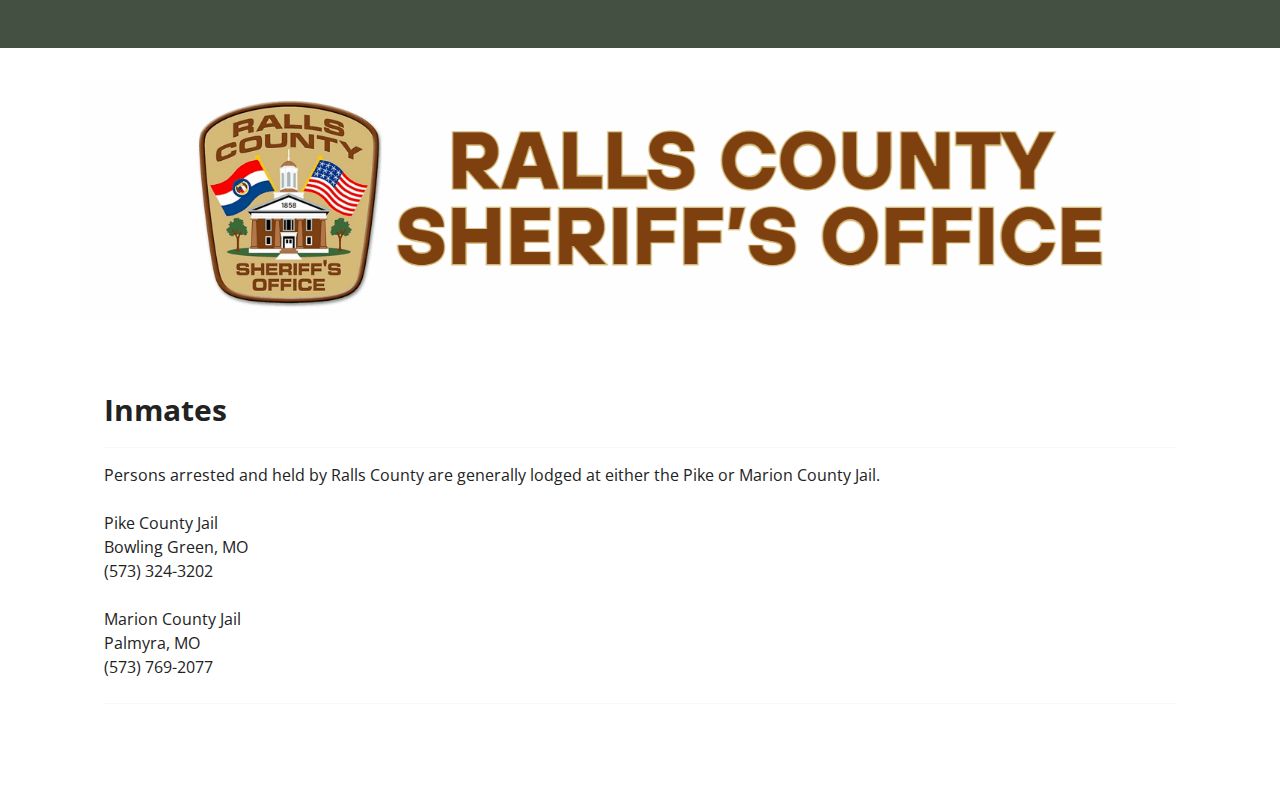
The image supports the two-jail route. It is not a 72-hour release list and does not say which facility held a named person.
Ralls does not publish a formula for deciding whether an arrestee goes to Pike or Marion. Do not guess from the arrest location, charge, or date. Ask Ralls first. Once the jail is known, direct the request to the agency that created the exit record. This records-custodian test limits delay and avoids paying two offices to search for material they did not make.
No official source identifies the release door, family waiting point, rideshare policy, or three-day transportation plan at either housing jail. Travel should not be arranged from a court entry alone. Confirm the site and person-specific timing with the facility.
Ralls Release Fallback Channels
The Ralls County Sunshine process is the leading fallback for county-created material. Its official page tells a requester to complete the form and send it to the proper officeholder. Section 610.023 requires action as soon as possible and no later than the end of the third business day after receipt, but production may take longer. When records cannot be supplied at once, the custodian must explain the delay and provide the earliest availability date.
Other systems answer narrower questions:
- Pike or Marion: physical release or transfer from the actual housing jail.
- Case.net: bond, judgment, dismissal, sentence, warrant, or court order in the Ralls case.
- MOVANS: an alert about one participating jail, MODOC, or court record, subject to lag and coverage.
- MODOC active search: a state prisoner, probationer, or parolee, but not a fully discharged person.
- MODOC historical data: current and former MODOC clients, with record and accuracy limits.
These channels should not be blended into one “release list.” A county jail exit, state-prison release to supervision, final MODOC discharge, and federal release belong to different systems. For a named person across those custody types, use the Ralls County released inmates lookup.
Read Ralls Release Results Correctly
A physical exit from Pike or Marion can end one jail episode while custody continues. The disposition field is critical. “Transfer to MODOC” means state custody follows. Transfer to another county means the receiving jail becomes the current source. A documented detainer can also produce a handoff instead of community release. No official evidence established an ICE housing contract for Ralls, Pike, or Marion, so an immigration transfer should never be assumed without a record.
| Finding | What it does not prove |
|---|---|
| Name left a current roster | It does not by itself prove release to the community. |
| Court case marked disposed | It does not establish the physical exit time. |
| Bond payment recorded | It does not prove all holds were cleared. |
| MODOC field assignment | It shows release from prison to supervision, not final discharge. |
| MOVANS change alert | It is not a certified jail release record. |
The strongest local proof pairs the housing jail’s date, time, and disposition with the legal case record. A state-prison matter instead pairs MODOC status and date material with the sentencing judgment. Each source has a distinct role.
Ralls Release Records After 72 Hours
The three-day period limits the event range, not the life of the underlying file. Missouri’s Sheriff records schedule sets a five-year minimum for arrest records and booking sheets. Inmate and detainee files have a minimum of five years after release and may include admission and release dates, reason for confinement, property receipts, and transfer information. Jail activity logs also have a five-year schedule.
These schedules do not require a web archive. They also do not make every part of every file public. Expungement, closing, juvenile status, active investigations, security, and other law can restrict access. For an older release, ask whether archival material remains and whether another schedule or legal hold applies.
Costs should be handled before a broad three-day search begins. Section 610.026 allows specified copy, research, staff, media, and programming charges, while the actual estimate depends on the work. Request electronic delivery, ask for an estimate, and give the office a cost ceiling. Supplying exact timestamps and a short field list helps prevent a search of records outside the intended period.
Note: If a request is denied, ask for the written statutory basis and keep the custodian’s referral to the agency that holds the record.